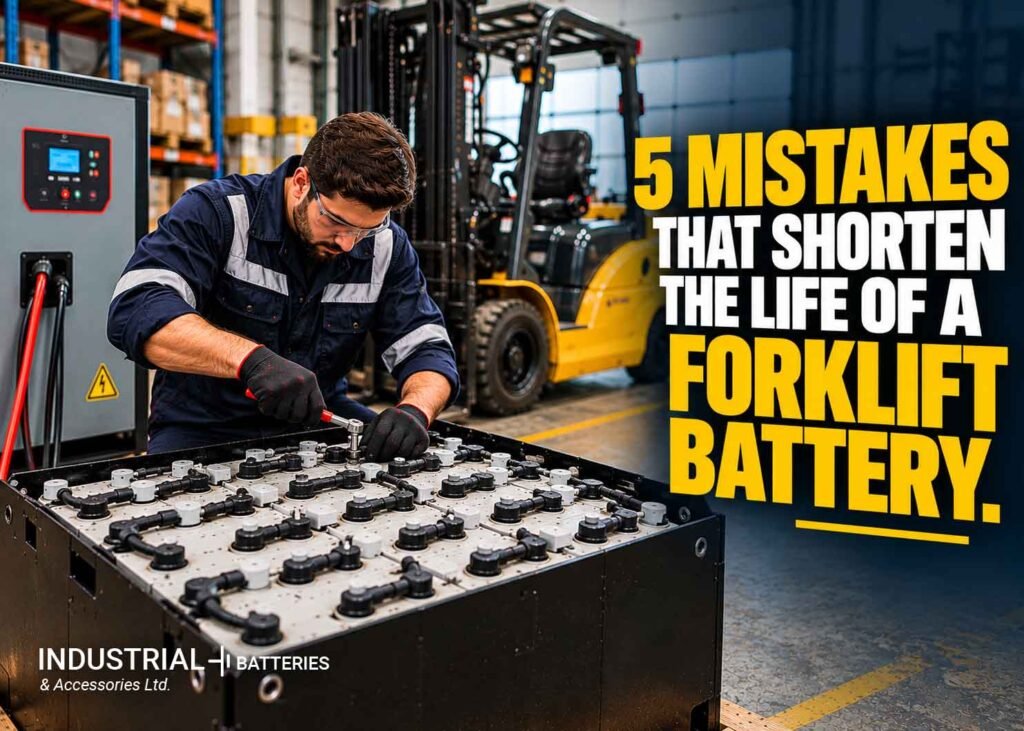
Most batteries do not die of old age. They die of habits.
Two warehouses can buy the same battery on the same day. One gets six years from it. The other replaces it in year three and wonders what went wrong. The answer usually sits in the charging room, in small shortcuts repeated every day.
This guide from Industrial Batteries Accessories Ltd. covers the five mistakes we see most, why they hurt, and how to stop them. Most of them are forklift battery charging mistakes, and every one is fixable.
Why Do Forklift Battery Charging Mistakes Cut Battery Life So Much?
Because they attack the plates, the part of the battery that wears out. Heat, flat discharges, and half charges all age the plates faster, so the battery loses capacity years early.
A lead acid forklift battery stores power in lead plates sitting in sulfuric acid. A charge cycle is one full run-down and recharge. Most batteries are built for about 1,500 cycles, which is roughly five years of one shift a day.
Good habits let the battery use all of those cycles. Bad habits waste them. A battery that gives out in year three instead of year five means you buy a second battery two years early, and your trucks run weak along the way.
The damage is slow, so it is easy to miss. That is why the habits matter more than any single event.
What Are the 5 Mistakes That Shorten the Life of a Forklift Battery?
The five mistakes are quick top-ups and early unplugging, running the battery flat, watering the wrong way, using a hot battery with no rest, and skipping checks. Each one has a clear fix.
1. Quick Top-Ups and Unplugging Early
Plugging in for 20 minutes at lunch feels harmless. Pulling a battery off the charger two hours early to catch the next shift feels like a good trade.
It is not. Short top-ups add heat and extra cycles on standard lead acid batteries. Early unplugging leaves some cells undercharged, and over time those cells fall behind. One weak cell can drag down the whole battery.
The fix: Let every charge finish. A full charge usually takes about eight hours. If your shifts leave no gap, add a spare battery instead of cutting the charge short.
2. Running the Battery Flat
Operators push on until the truck stops. It saves a trip to the charger, but it stresses the plates every time.
Deep discharge also sets the stage for sulfation, a hard crystal buildup on the plates that blocks power storage. Light sulfation can sometimes be reversed. Heavy sulfation cannot.
The fix: Recharge near 20 percent charge left. Many makers advise this. Train operators to plug in when the gauge says so, not when the truck gives up.
3. Watering the Wrong Way
Here is a pattern we see often. A supervisor tops up every cell to the full line before charging. During the charge, the liquid expands and pushes acid out of the cells. Next morning there is acid on the battery top and crust on the posts.
Other watering mistakes include using tap water, which leaves minerals behind, and letting plates dry out, which damages them quickly.
The fix: Add distilled water after charging, never before. Cover the plates, and do not overfill. Check levels weekly, and more often in hot weather.
4. Using a Hot Battery With No Rest
A battery warms up while it charges. Putting it straight back to work keeps the heat in, and heat is hard on the plates.
This one hits multi-shift sites hardest. One battery per truck means no rest, no full charge, and fast wear.
The fix: Let the battery rest after charging. Many makers suggest about eight hours, so follow yours. Use a second battery on multi-shift trucks and rotate them on a fixed schedule.
5. Skipping Checks, Cleaning, and the Charger
Dirt, acid residue, loose plugs, and a faulty charger do quiet damage. Crust forms on the posts, connectors heat up, and a charger that overcharges boils off water.
Nobody notices until the battery fades. By then, several problems are stacked together.
The fix: Wipe the top weekly, inspect plugs every shift, and test the charger along with the battery. Write down what you find so trends show up early.
How Do You Spot the Damage Early?
Watch for shorter run time, heat, slow charging, heavy water use, and crust on the posts. Each sign points back to one of the five mistakes.
Use this table to connect the sign to the habit:
| What you see | Likely mistake |
| Run time keeps shrinking | Quick top-ups, deep discharge |
| Battery feels hot | No rest, overcharging |
| Water use climbs | Overcharging, heat |
| Crust on posts | Overfilling, dirty top |
| One cell reads low | Early unplugging, deep discharge |
| Charge never finishes | Charger fault, sulfation |
A hydrometer measures the strength of the liquid in each cell. Healthy cells read close to each other. Take readings monthly and keep them in a log.
What Forklift Battery Charging Best Practices Stop These Mistakes?
Plug in near 20 percent, let each charge finish, water after charging, rest the battery, and match the charger to the battery. These forklift battery charging best practices fix mistakes one through four.
Follow this routine:
- Plug in at the right time. Aim for about 20 percent charge left.
- Check the plug and cable. Make sure the connection is tight and undamaged.
- Let the full cycle finish. Do not interrupt it.
- Water after the charge. Use distilled water only.
- Rest the battery. Give it time to cool before the next shift.
- Use an equalizing charge when advised. This longer charge evens out cell strength. Many makers suggest one every 5 to 10 cycles, so confirm yours.
Wear gloves and eye protection. Charging gives off hydrogen gas, so ventilate the room and keep sparks and flames away.
What Forklift Battery Care Tips Add the Most Years?
Weekly cleaning, tight connections, regular cell readings, and a yearly professional test add the most years. These forklift battery care tips take minutes and protect a battery that costs thousands.
- Wipe the top weekly. Clean metal gives acid nothing to cling to.
- Check connectors every shift. Heat marks and crust show up early.
- Keep vent caps tight.
- Log cell readings monthly. One low cell is a warning.
- Rotate batteries on multi-shift trucks.
- Book a yearly test. Include the charger.
These forklift battery maintenance tips work best as a written routine. Give each task an owner and post the list near the chargers. A task everyone owns is a task no one does.
If you keep a log, you also have records for any warranty claim. Read the warranty book so you know what your battery’s warranty expects.
Can a Damaged Battery Still Be Saved?
Often, yes. Damage from these habits is not always permanent. A test will show whether the battery needs repair, regeneration, a rebuild, or replacement.
Here is a quick guide:
- Corrosion or worn cables: Repair through battery service and repairs.
- Over-discharged battery with life left: Battery regeneration can recover lost cycles.
- Several weak cells: A battery pack rebuild is often the better value.
- Cracked case or past 1,500 cycles: A new forklift battery.
When repair bills near the price of a rebuild, stop repairing. Then fix the habits behind the damage, or forklift battery charging mistakes will shorten the next battery too.
Frequently Asked Questions
What is the biggest mistake that shortens forklift battery life?
Most sites lose the most life to quick top-ups and early unplugging. Both leave cells undercharged and add heat. Letting every charge finish is the easiest fix.
Is it bad to charge a forklift battery every night?
No. Charging after each shift is normal for a lead acid battery. The problem is unplugging early or skipping the rest period, not charging often.
Can I add water before charging?
Only if the plates are exposed. Cover the plates first, then add the rest of the water after charging. Watering to the full line before a charge can push acid out of the cells.
How do I know if I have been making these mistakes?
Look for shorter run time, heat, heavy water use, crust on the posts, and uneven cells. A technician can test the battery and tell you what is wearing it out.
Can I stop damage once it has started?
You can slow it. Fixing the habits protects the plates that remain, and some damage can be reversed. Get the battery tested before deciding.
Which Mistake Is Costing You Battery Life?
Batteries wear out slowly, and so do the habits that kill them. Pick one of the five mistakes you recognize, fix it this week, and watch the log. Small changes add up to years.
The team at Industrial Batteries Accessories Ltd. can test your batteries and chargers, spot what is wearing them out, and quote repair, rebuild, or replacement so you can compare. Request a free estimate on the quote page, or reach the team through the contact page