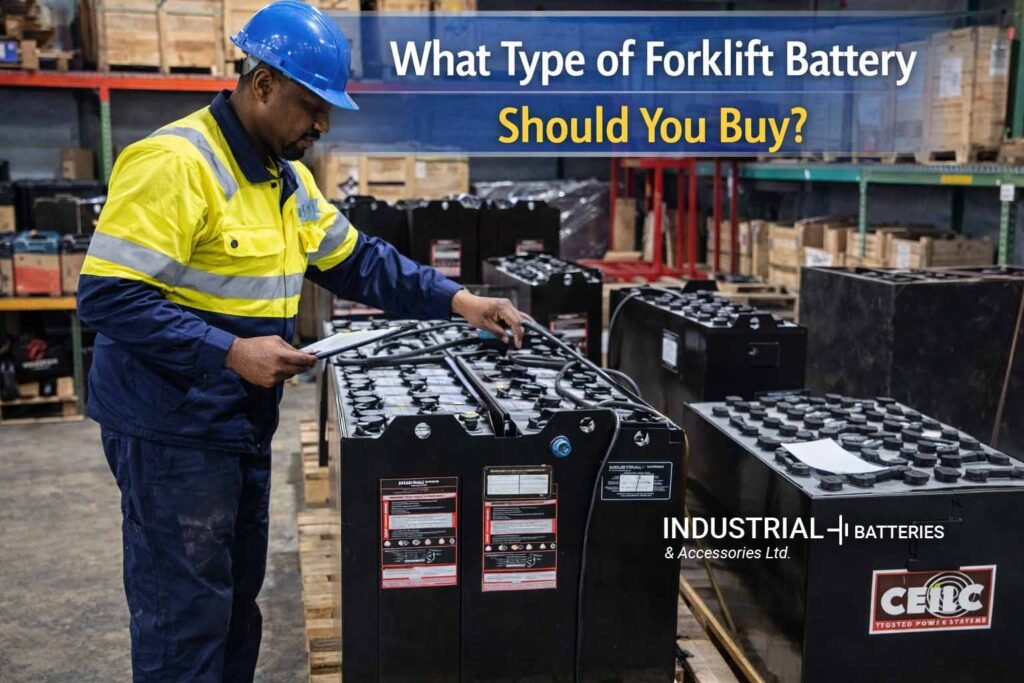
Choosing a forklift battery is not just about finding one that fits inside the forklift. The battery must match the forklift, the charger, the daily workload, and the way your team operates.
A good forklift battery helps your equipment run smoothly through the workday. A poor match can lead to short run time, slow charging, higher maintenance, and more downtime.
If you are planning to buy forklift batteries, this guide will help you understand the main options in simple words. It will also explain how to choose the best forklift battery for your business needs.
Why Forklift Battery Selection Matters
Forklift battery selection affects more than power. In many electric forklifts, the battery also helps balance the machine. That means the battery must have the right size and weight, not only the right voltage.
A wrong battery can cause problems such as:
- Poor run time
- Slow charging
- Unsafe weight balance
- Charger mismatch
- Extra maintenance
- Battery overheating
- Higher repair costs
- Unexpected downtime
The right industrial forklift battery should support your workload without putting extra stress on your forklift or charging system.
Start With Your Forklift Requirements
Before choosing any battery, check your forklift’s requirements. Every forklift has specific battery needs.
You should confirm:
- Battery voltage
- Battery compartment size
- Required battery weight
- Amp-hour rating
- Connector type
- Charger type
- Daily working hours
- Load weight and lift use
You can usually find these details on the forklift data plate or old battery label. If you are not sure, ask a trained supplier or technician to check before buying.
Never guess the battery size or voltage. A wrong match can cause poor performance and safety concerns.
Lead-Acid Forklift Batteries
Lead-acid batteries are one of the most common choices for electric forklifts. They have been used in warehouses and industrial sites for many years.
These batteries are usually reliable when they are charged and maintained correctly.
A lead-acid forklift battery may be right if:
- Your forklift works one shift per day
- You have time for full charging
- You can allow cooling time after charging
- Your team can handle watering and cleaning
- You already have lead-acid chargers
- You want a widely available battery option
Lead-acid batteries usually cost less upfront than lithium batteries. But they need more regular care.
They may require watering, cleaning, equalizing, and proper charging habits. They also need a safe and ventilated charging area.
Lithium Forklift Batteries
Lithium forklift batteries are becoming more common in busy operations. They charge faster than many lead-acid batteries and usually need less daily maintenance.
A lithium battery may be a good choice if:
- Your forklifts work multiple shifts
- You need shorter charging breaks
- You want less watering and cleaning
- You have limited space for spare batteries
- You want easier daily battery care
- Your operation needs steady power for longer periods
Lithium batteries often cost more at the beginning. But they may reduce maintenance time and charging delays in the right setting.
They must be used with the correct charger. Do not assume a lead-acid charger will work with a lithium battery.
New Forklift Batteries
A new forklift battery is often the best choice for heavy daily use. It gives you the strongest expected performance and usually comes with better warranty support.
A new battery may be the right option if:
- Your forklift is used every day
- Downtime is costly
- You need dependable run time
- You want longer service life
- You are replacing a badly worn battery
- You want clear warranty protection
New batteries usually cost more than used or reconditioned batteries. But they may offer better long-term value when the forklift is important to daily work.
Used Forklift Batteries
Used forklift batteries can be useful in the right situation. They may cost less upfront, which can help if the forklift is used lightly.
A used battery may work if:
- The forklift is not used heavily
- You need a backup battery
- Your budget is limited
- The battery has been tested properly
- The supplier explains its condition clearly
- Warranty terms are fair
Do not buy a used battery without test results. A low price can become expensive if the battery fails soon after purchase.
Ask about run time, age, maintenance history, and warranty before buying.
Reconditioned Forklift Batteries
A reconditioned forklift battery is a used battery that has been serviced to improve its performance. It may be cleaned, tested, repaired, or restored depending on its condition.
A reconditioned battery may be a practical middle option between new and used.
It may be suitable if:
- You need a lower-cost option
- The forklift has moderate use
- The battery has been properly tested
- You receive clear warranty details
- The supplier has a good service process
Quality can vary, so supplier trust matters. A reliable supplier should explain what work was done and what performance you can expect.
How To Match Battery Voltage
Voltage must match the forklift. Common forklift battery voltages include 24V, 36V, 48V, 72V, and 80V.
A forklift designed for 48V should use a 48V battery. A wrong voltage can damage the forklift and create safety risks.
Before you buy forklift batteries, always check the voltage label. This is one of the most important steps in battery selection.
How To Match Battery Size And Weight
A forklift battery must fit properly inside the battery compartment. It also must meet the forklift’s weight requirement.
The battery weight matters because it helps balance the forklift during lifting. If the battery is too light, the forklift may become less stable.
Check:
- Length
- Width
- Height
- Weight
- Cable position
- Connector location
A battery that does not fit correctly can create daily problems for operators.
Think About Run Time
Run time means how long the battery can power the forklift before it needs charging. This depends on battery capacity and how the forklift is used.
A forklift that lifts heavy loads all day will use more power than one used for light movement.
Ask these questions:
- How many hours does the forklift run daily?
- Are loads heavy or light?
- Is the forklift used constantly or occasionally?
- How far does it travel?
- How high does it lift?
- How many shifts do you run?
The best forklift battery is the one that supports your real workday, not just the one with the lowest price.
Check Charger Compatibility
The charger must match the battery. This includes voltage, battery type, amp-hour rating, charging profile, and connector.
A mismatched charger can cause:
- Slow charging
- Overheating
- Undercharging
- Overcharging
- Short battery life
- Charger fault codes
If you switch from lead-acid to lithium, you may need a different charger. Always confirm charger compatibility before buying.
Consider Maintenance Requirements
Different batteries need different levels of care.
Lead-acid batteries may need:
- Watering
- Cleaning
- Equalizing
- Cooling time
- Ventilation
- Regular inspection
Lithium batteries usually need less daily care, but they still need proper charging, safe handling, and correct storage.
Choose a battery your team can maintain properly. A battery that is not cared for will not perform well, even if it is high quality.
Compare Total Value, Not Only Price
Battery price is important, but it should not be the only factor. A cheap battery may cost more later if it has short run time, poor support, or early failure.
Compare:
- Battery life
- Run time
- Warranty
- Maintenance needs
- Charging time
- Supplier support
- Charger compatibility
- Downtime risk
- Delivery and installation
A good industrial forklift battery should fit your operation and protect productivity.
When Should You Replace Your Forklift Battery?
You may need a replacement when the battery no longer supports your daily work.
Common signs include:
- Short run time
- Slow charging
- Frequent overheating
- Strong smell during charging
- Damaged case
- Leaking
- Corroded terminals
- Charger faults
- Battery not holding charge
- Forklift losing power quickly
Some of these signs can also come from charger problems. Test both the battery and charger before replacing anything.
Simple Buying Checklist
Before you buy, review this checklist:
- Confirm forklift voltage
- Confirm battery size
- Confirm battery weight
- Check amp-hour rating
- Choose battery type
- Match the charger
- Review workload
- Compare new, used, and reconditioned options
- Ask about warranty
- Confirm delivery and installation
- Choose a supplier with service support
This simple checklist can help you avoid costly mistakes.
Choose The Battery That Fits Your Work
The best forklift battery is the one that fits your forklift, charger, workload, budget, and maintenance routine. Lead-acid batteries may work well for standard use and planned charging. Lithium batteries may fit busy operations that need faster charging and lower daily maintenance. New batteries may suit heavy use, while tested used or reconditioned batteries may work for lighter needs.
Take time to compare your options before buying. A careful choice can improve run time, reduce downtime, and make daily work easier.
For help choosing the right forklift battery for your business, contact Industrial Batteries Accessories Ltd. and get practical guidance based on your equipment and workload.
FAQs
What Is The Best Forklift Battery To Buy?
The best forklift battery is the one that matches your forklift voltage, size, weight, charger, workload, and daily operating needs.
Should I Buy Lead-Acid Or Lithium Forklift Batteries?
Lead-acid batteries can work well for planned charging and regular maintenance. Lithium batteries may be better for faster charging and multi-shift use.
Can I Use Any Forklift Battery In My Forklift?
No. The battery must match the forklift’s voltage, size, weight, connector, and power needs.
Is A Used Forklift Battery Worth Buying?
A used forklift battery can be worth buying for light use or backup needs, but it should be tested and sold with clear warranty terms.
How Do I Know My Forklift Battery Needs Replacement?
Short run time, slow charging, overheating, leaking, corrosion, and weak forklift power can be signs. Test the charger too before replacing the battery.
What Should I Check Before Buying A Forklift Battery?
Check voltage, size, weight, amp-hour rating, battery type, charger compatibility, warranty, and supplier support.