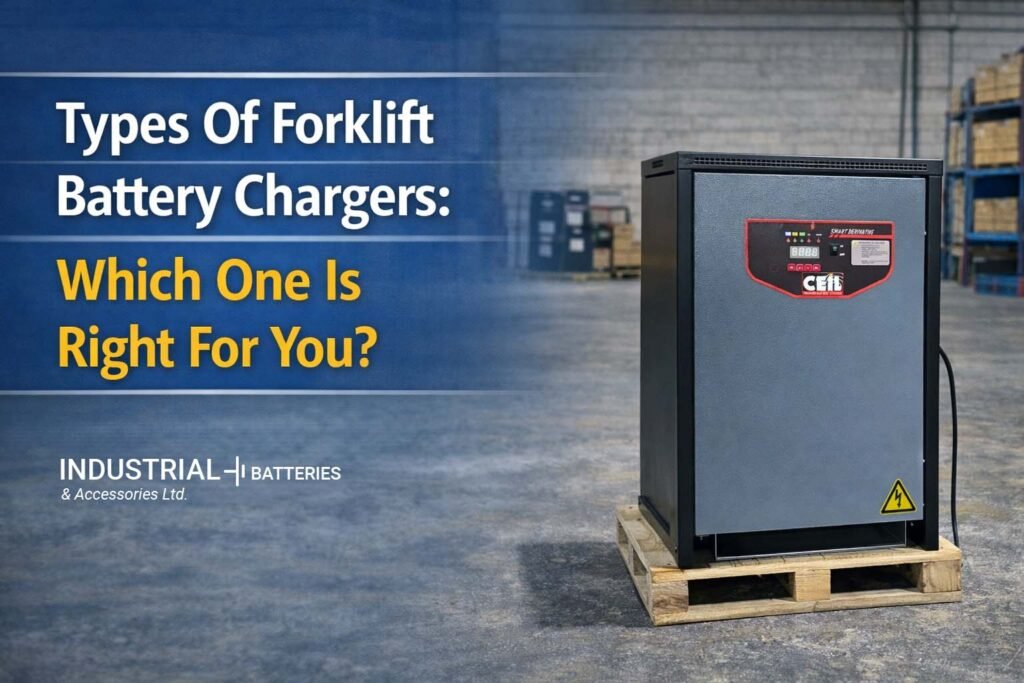
A forklift battery charger may look like simple equipment, but it plays a major role in daily operations. If the charger is not right for the battery, the forklift may lose power too soon, charge too slowly, or need more maintenance than expected.
The right charger helps your forklift stay ready for work. It also supports battery life, safer charging, and better shift planning. This is why charger selection should never be treated as a guess.
This guide explains the main types of forklift battery chargers in simple terms. It will help you understand what each charger does, where it works best, and how to choose the best forklift battery charger for your operation.
Why Forklift Charger Selection Matters
Every forklift battery needs the right charging method. A charger must match the battery voltage, battery type, battery capacity, and daily usage pattern.
Using the wrong charger can create several problems, such as:
- Slow charging
- Shorter battery run time
- Overheating
- Battery damage
- Higher energy use
- More downtime
- Safety concerns in the charging area
A good forklift charger selection guide always starts with one question: how is the forklift used every day?
A forklift used for light warehouse work may not need the same charger as a forklift running through long shifts. A busy operation needs a charger that can support its work schedule without hurting the battery.
Conventional Forklift Battery Chargers
Conventional chargers are the traditional type of forklift battery chargers. They are often used with lead-acid forklift batteries. These chargers usually work best when a battery can be charged fully over several hours.
This type of charger is common in operations where forklifts are used during one shift and charged overnight.
A conventional charger may be a good fit if:
- Your forklift runs on a single shift
- The battery can charge overnight
- You use standard lead-acid batteries
- Your charging schedule is simple
- You do not need quick charging between shifts
The main benefit is simplicity. These chargers are known, familiar, and widely used. The main drawback is charging time. They are not ideal when batteries need to return to work quickly.
Opportunity Chargers
Opportunity chargers are used when a battery needs short charging sessions during breaks, lunch periods, or shift changes. Instead of waiting until the battery is fully discharged, the battery gets small boosts throughout the day.
This can be helpful in busy operations where forklifts are used for many hours.
An opportunity charger may be useful if:
- Forklifts work across multiple shifts
- Batteries need quick charging during breaks
- You want to reduce battery changes
- You have limited spare batteries
- Your team follows a planned charging schedule
However, opportunity charging must be managed carefully. Not every battery is suitable for this charging style. If done incorrectly, it can increase heat and reduce battery life.
This is why the battery, charger, and work schedule must all match.
Fast Chargers
Fast chargers are designed to charge forklift batteries more quickly than standard chargers. They are often used in demanding workplaces where long charging windows are not available.
Fast charging can reduce downtime, but it also places more stress on the battery if the system is not managed properly.
A fast charger may be right if:
- Your forklifts run for long hours
- Charging time is limited
- Downtime is expensive
- Your battery is designed for fast charging
- Your charging area has the right power setup
Fast chargers are not always the best choice for every operation. They may need stronger electrical infrastructure. They may also require better temperature control and closer battery monitoring.
For some businesses, fast charging is helpful. For others, it may be more than they need.
High-Frequency Chargers
High-frequency chargers are a more efficient type of industrial battery chargers. They are usually smaller, lighter, and more energy-efficient than older charger designs.
These chargers convert power more efficiently and can help reduce energy waste. Many newer charging systems use high-frequency technology.
High-frequency chargers may be a good choice if:
- You want better energy efficiency
- You want a smaller charger footprint
- You are updating older charging equipment
- You need better charging control
- You want a modern charger for daily use
They are often used in warehouses, manufacturing spaces, distribution centers, and logistics operations.
For many businesses, a high-frequency charger is a practical upgrade from older charging systems.
Smart Forklift Battery Chargers
A smart forklift battery charger uses advanced controls to manage the charging process. It can adjust charging based on battery condition, voltage, temperature, and charging stage.
This makes charging more controlled and often safer for the battery.
A smart charger may help prevent common charging issues like overcharging, undercharging, and unnecessary heat.
A smart forklift battery charger may be right if:
- You want better battery protection
- You manage several forklifts
- You need more charging data
- You want fewer charging mistakes
- You use modern battery systems
- You want better control over battery health
Smart chargers are especially helpful when the same charging area is used by different operators. The charger can reduce human error by managing more of the charging process on its own.
Chargers For Lead-Acid Forklift Batteries
Lead-acid batteries are still widely used in forklift operations. These batteries need proper charging, watering, cooling time, and maintenance.
A charger for a lead-acid battery must match the battery voltage and amp-hour rating. It should also support the correct charging profile.
Lead-acid batteries often need a full charge cycle. They also need time to cool after charging before being used again.
This type of battery usually works well when:
- Charging can happen after a shift
- The operation has a battery maintenance routine
- Watering is done correctly
- The battery has enough time to cool
- The charger is matched properly
Poor charging can shorten lead-acid battery life. So, the charger must be selected carefully.
Chargers For Lithium Forklift Batteries
Lithium forklift batteries need a different charging approach. They often charge faster and do not require watering. Many lithium batteries are designed for opportunity charging.
However, they must be charged with the correct lithium-compatible charger. A charger made for lead-acid batteries should not be used unless it is approved for that battery type.
Lithium chargers are often used where:
- Fast charging is important
- Operators need short charging breaks
- Battery maintenance time must be reduced
- Multi-shift work is common
- Space for spare batteries is limited
Lithium systems usually include battery management controls. These controls help protect the battery during charging and use.
Single-Phase And Three-Phase Chargers
Forklift chargers also differ by power input. Some use single-phase power, while others use three-phase power.
Single-phase chargers are often used for smaller equipment or lighter charging needs. Three-phase chargers are common in industrial settings where larger batteries and higher power output are needed.
Before choosing a charger, check your facility’s electrical setup. A charger that needs more power than your building can provide may require electrical upgrades.
This is an important step in any forklift charger selection guide.
How To Choose The Right Forklift Battery Charger
Choosing the right charger becomes easier when you look at the full operation, not just the forklift.
Start with these points:
- Battery voltage
- Battery amp-hour capacity
- Battery chemistry
- Forklift usage hours
- Number of shifts
- Charging window
- Available power supply
- Charging room space
- Heat and ventilation
- Maintenance routine
- Future equipment needs
The best forklift battery charger is not always the fastest or most expensive option. It is the charger that matches your battery, work schedule, and facility setup.
Common Mistakes To Avoid
Many charger problems start with poor selection. A charger may seem fine at first, but problems appear later when the battery does not perform well.
Avoid these mistakes:
- Choosing a charger without checking battery details
- Using the same charger for different battery types
- Ignoring voltage and capacity
- Buying a fast charger without checking power supply
- Charging lead-acid batteries without cooling time
- Using damaged cables or connectors
- Ignoring heat, fault codes, or slow charging
- Treating charger selection as only a price decision
A charger is part of the whole power system. It should be chosen with care.
What Type Of Charger Is Best For Your Operation?
The right choice depends on how your forklifts work each day.
A conventional charger may be enough for a simple one-shift operation. An opportunity charger may help when forklifts need short charging sessions through the day. A fast charger may support high-demand work, but only when the battery and facility are ready for it. A high-frequency charger may be a smart upgrade for better efficiency. A smart charger may be best when you want more control and better battery protection.
The goal is not to choose the most advanced charger. The goal is to choose the charger that keeps your forklifts working safely and reliably.
Choose A Charger That Supports Your Workday
Forklift charging should fit your daily workflow. When the charger matches the battery and operation, charging becomes easier, safer, and more dependable.
Before buying or replacing a charger, review your battery type, shift schedule, power supply, and charging habits. This helps avoid poor performance and unnecessary costs.
For help choosing the right industrial battery chargers, speak with Industrial Batteries Accessories Ltd. and get practical guidance based on your forklift battery needs.
FAQs
What Is The Best Forklift Battery Charger?
The best forklift battery charger is the one that matches your battery voltage, battery type, battery capacity, and daily work schedule.
Can I Use Any Charger For A Forklift Battery?
No. The charger must match the battery. Using the wrong charger can damage the battery and create safety problems.
What Is A Smart Forklift Battery Charger?
A smart forklift battery charger controls the charging process based on battery needs. It can help reduce overcharging, undercharging, and heat.
Are Fast Chargers Good For Forklift Batteries?
Fast chargers can be helpful, but only if the battery is designed for fast charging and the facility has the right power setup.
What Is The Difference Between Conventional And Opportunity Charging?
Conventional charging is usually done after a shift. Opportunity charging gives the battery short charging boosts during breaks or shift changes.
How Do I Know Which Forklift Charger I Need?
Check the battery voltage, amp-hour rating, battery type, work schedule, charging time, and available power supply before selecting a charger.