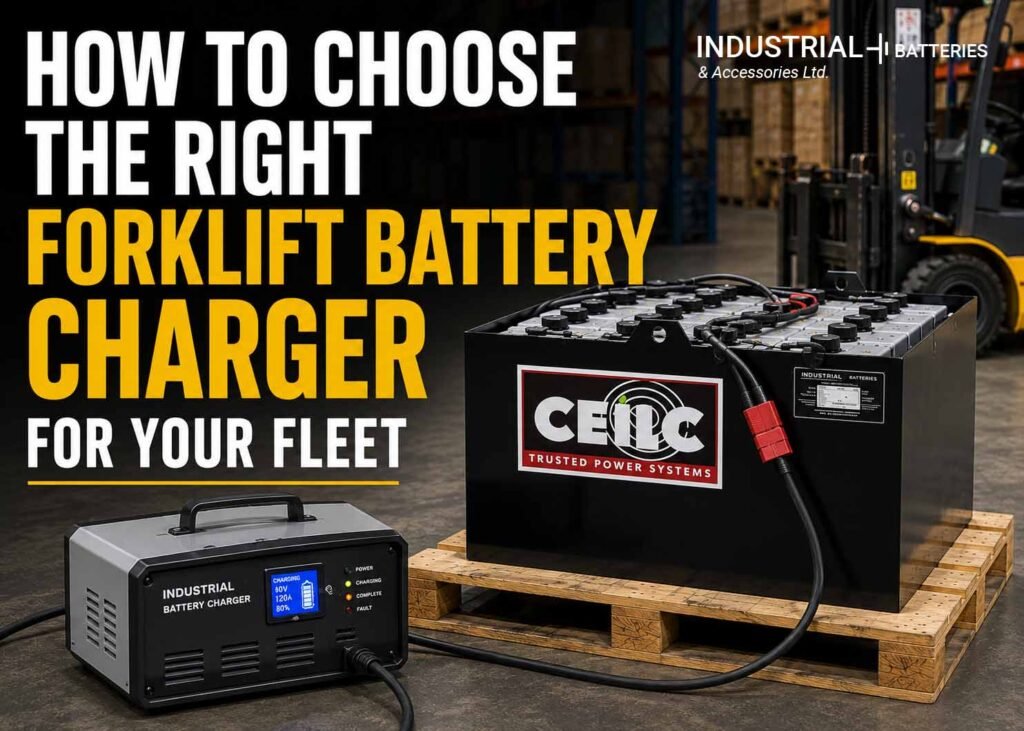
A forklift battery charger is not a small purchase. It affects how long your forklifts run, how often batteries need service, and how smoothly your warehouse operates each day. A good charger supports battery life and keeps equipment ready for work. A poor charger can cause slow charging, battery damage, downtime, and higher operating costs.
For Canadian warehouses, distribution centres, manufacturing plants, and logistics operations, charger selection should never be rushed. Your fleet size, battery type, shift schedule, charger location, and daily workload all matter. The right forklift battery charger must match the way your business actually works.
This guide explains how to choose the right charger for your fleet and what to check before you invest in electric forklift charging solutions.
Start With Your Battery Type
The first step is to know what type of forklift battery your fleet uses. Most operations use either lead-acid batteries or lithium-ion batteries. These batteries charge differently, so they need the right charger.
Lead-acid batteries usually need a controlled full charging cycle. They may also need cool-down time after charging. Lithium-ion batteries can often support faster charging and opportunity charging, but they need a charger that works with the battery’s management system.
Do not assume one charger can safely charge every battery in your fleet. The charger must match the battery chemistry, voltage, and capacity. Using the wrong charger can shorten battery life and create safety concerns.
Match The Charger Voltage To The Battery
Voltage must match. This is one of the most basic rules in forklift charger selection. A 24-volt battery needs a 24-volt charger. A 36-volt battery needs a 36-volt charger. A 48-volt battery needs a 48-volt charger.
If the voltage is wrong, the battery may not charge properly. It may also become damaged. In some cases, the charger may not work at all.
Before buying industrial battery chargers, check the battery nameplate or battery documentation. If you manage multiple forklifts, record the voltage of each battery. This helps you avoid confusion and prevents operators from connecting the wrong charger.
Check Battery Amp-Hour Capacity
Amp-hour capacity tells you how much energy the battery can store. A charger must be sized correctly for this capacity. If the charger is too small, charging may take too long. If it is too powerful for the battery, it may cause stress or damage.
For lead-acid batteries, many operations choose a charger based on a safe charging rate that fits the shift schedule. For lithium batteries, the charger selection may depend on how quickly the fleet needs to return to service and what the battery manufacturer allows.
The goal is not always to choose the fastest charger. The goal is to choose a charger that charges safely, reliably, and within the battery’s limits.
Understand Your Shift Schedule
Your operating schedule has a major impact on charger selection. A single-shift warehouse has different charging needs than a two-shift or three-shift operation.
If forklifts are used for one shift and parked overnight, a standard charger may be enough. If forklifts run across multiple shifts, you may need faster charging, spare batteries, opportunity charging, or a more advanced charging setup.
Ask simple questions before choosing a forklift battery charger. How many hours does each forklift run per day? How much time is available for charging? Do batteries have enough time to cool down? Do operators need to charge during breaks? These answers help you choose a charger that fits real daily use.
Choose Between Conventional And High-Frequency Chargers
Traditional chargers are still used in many facilities, but high-frequency chargers are now common because they are more efficient and often more compact. A high-frequency charger can reduce energy waste and support better charging control.
For many warehouses, this can be a smart upgrade. Lower energy use may also help reduce operating costs over time. High-frequency chargers can also be easier to install in facilities where space is limited.
That said, the charger must still match the battery and workload. Do not choose a charger only because it sounds advanced. Choose it because it fits your battery system and operating needs.
Think About Charging Time
Charging time matters because downtime costs money. If a forklift is waiting for a battery, work slows down. Orders can be delayed. Operators may have to switch equipment or wait for the battery to charge.
The right electric forklift charging solutions should support your daily workflow. In a light-use operation, overnight charging may be enough. In a high-volume warehouse, you may need faster chargers or several charging points to keep the fleet moving.
Be careful with fast charging. Faster is not always better if the battery is not designed for it. Charging too aggressively can shorten battery life. Always balance charging speed with battery health.
Review Your Charging Area
Your charging area should be safe, organized, and easy to access. Before choosing forklift charging systems, look at your available space. Chargers should not block walkways, forklift routes, emergency exits, or loading areas.
Lead-acid battery charging areas may need proper ventilation, PPE, eyewash access, spill response supplies, and clear safety signage. Lithium charging areas may have different requirements, but they still need safe installation and proper electrical setup.
A good charger is only part of the system. The charging area must also support safe and efficient use.
Check Your Electrical Capacity
Industrial battery chargers need the right electrical supply. Before buying a charger, confirm that your facility can support it. This includes voltage supply, phase requirements, breaker size, wiring, and available power.
A charger that does not match your electrical setup can create installation delays and added costs. In some cases, your facility may need upgrades before the charger can be used.
This is an important step for Canadian businesses planning fleet growth. If you expect to add more electric forklifts later, think ahead. It may be smarter to design your charging area for future demand instead of only solving today’s need.
Consider The Number Of Chargers You Need
One charger may not be enough for a fleet. The right number depends on how many forklifts you operate, how many batteries you use, and how often they need charging.
A small warehouse may manage with one charger. A larger facility may need several chargers placed in a central charging area. A multi-shift operation may need a planned charging schedule to prevent delays.
Too few chargers can create bottlenecks. Too many chargers can waste money and space. The best approach is to match charger count to daily usage patterns.
Look For Smart Charging Features
Modern industrial battery chargers may include smart features that help protect the battery and improve efficiency. These features can include automatic shutoff, charge monitoring, fault detection, temperature control, equalization settings, and usage tracking.
Smart charging features are useful because they reduce guesswork. They help prevent overcharging and undercharging. They can also help managers spot battery problems before they cause downtime.
For fleets with several forklifts, charger data can be valuable. It can show which batteries are being overused, which chargers are used most often, and where charging habits need improvement.
Think About Operator Ease Of Use
A charger should be easy for trained staff to use. If the system is confusing, mistakes are more likely. Clear displays, simple controls, proper connector fit, and visible status lights can make daily charging smoother.
Operators should know when a battery is charging, when it is fully charged, and when there is a fault. They should also know which charger matches which battery.
Good labelling helps. Clear procedures help even more. A simple charging system can reduce errors and improve safety.
Do Not Ignore Connectors And Cables
The charger may be correct, but poor connectors or damaged cables can still cause problems. Cables should be strong, properly rated, and long enough to reach safely without being stretched across walkways.
Connectors should match the battery and forklift system. Loose or worn connectors can cause heat buildup, poor charging, or equipment faults.
When buying a forklift battery charger, check the full setup. The charger, cables, connectors, and battery must work together safely.
Compare Long-Term Value, Not Just Price
The cheapest charger may not be the best choice. A low-cost charger that charges slowly, wastes energy, or damages batteries can cost more over time.
Look at the full value. Consider energy efficiency, battery protection, charging speed, reliability, warranty, service support, and compatibility with your fleet. A better charger can reduce downtime and help extend battery life.
For businesses that depend on forklifts every day, long-term reliability matters more than a small upfront saving.
Ask About Service And Support
Industrial battery chargers need support. If a charger fails, your fleet can lose productive time quickly. Choose a supplier that can help with charger selection, installation guidance, troubleshooting, parts, and future replacement needs.
This is especially important for businesses with several forklifts or mixed battery types. A supplier that understands forklift charging systems can help you avoid costly mistakes.
Good support also helps when your fleet changes. If you add equipment, switch battery types, or expand your warehouse, you may need to adjust your charging setup.
Common Mistakes To Avoid
One common mistake is buying a charger without checking battery specifications. Another is choosing a charger only by price. Some businesses also forget to check electrical capacity before ordering.
Another mistake is failing to plan for growth. A charger setup that works for two forklifts may not work for six. If your business is growing, your charging system should be able to grow with it.
Avoid mixing chargers and batteries without proper confirmation. Compatibility is not something to guess.
FAQs
What Is The Most Important Factor When Choosing A Forklift Battery Charger?
The most important factor is compatibility. The charger must match the battery voltage, chemistry, and amp-hour capacity. It should also fit your shift schedule and charging needs.
Can One Charger Work For Different Forklift Batteries?
Sometimes, but only if the charger is designed for those batteries and settings are correctly matched. Never assume one charger can safely charge every battery in your fleet.
Are High-Frequency Forklift Chargers Better?
High-frequency chargers are often more efficient and compact than older charger types. They can be a strong choice for many warehouses, but they must still match your battery and workload.
How Many Forklift Chargers Does A Fleet Need?
It depends on fleet size, battery usage, shift schedule, and charging time. A multi-shift operation usually needs more charging capacity than a single-shift warehouse.
Should I Choose Fast Charging For My Forklift Fleet?
Fast charging can help some operations, especially high-use fleets, but it must be compatible with the battery. Charging too fast with the wrong setup can reduce battery life.
Conclusion
Choosing the right forklift battery charger is about more than plugging in a battery. It requires a clear look at battery type, voltage, amp-hour capacity, shift schedule, charging time, electrical supply, charger features, and long-term support.
The right charger can improve productivity, reduce downtime, protect battery life, and support safer daily operations. The wrong charger can create delays, damage batteries, and increase costs. For reliable forklift charger selection, industrial battery chargers, and electric forklift charging solutions, contact Industrial Batteries for practical guidance and dependable charging systems built around your fleet’s needs.