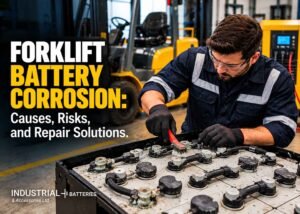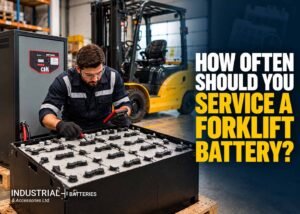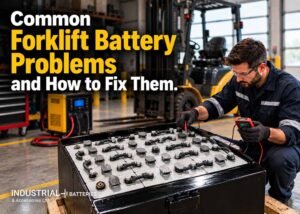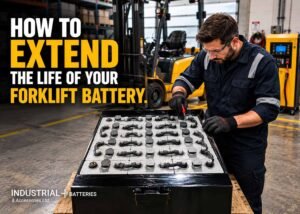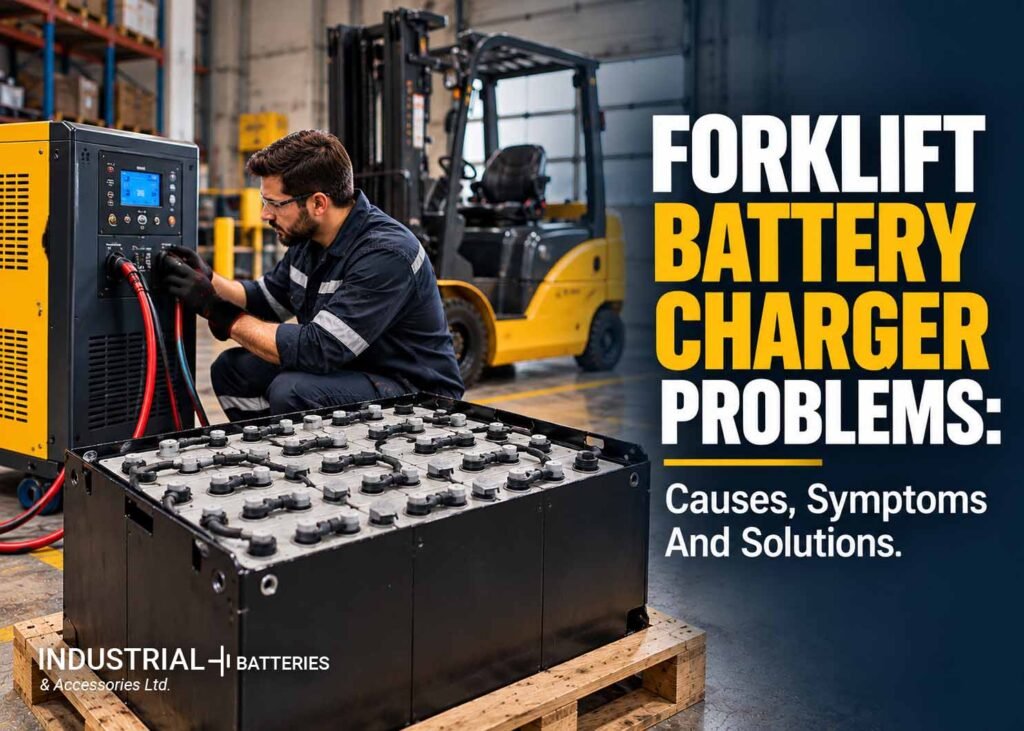
The charger light turns green. The operator unplugs the battery and drives off. Two hours later the truck is crawling, so the battery gets blamed and someone starts pricing a new one.
Then a supervisor checks the charger. It has been quitting early for weeks.
Forklift battery charger problems often look like battery problems. Short run time, heat, and slow charging can come from either side of the plug. This guide from Industrial Batteries Accessories Ltd. shows how to tell the difference, what causes each fault, and how to fix it before it costs you a battery.
What Are the Most Common Forklift Battery Charger Problems?
Six faults cause most trouble: no power, early shutoff, overcharging, overheating, damaged cords or connectors, and a charger that does not match the battery. Each one leaves clear clues you can spot in a few minutes.
Here is how to match the symptom to the likely cause:
| Symptom | Likely cause | First check |
| Charger will not turn on | No power, tripped breaker, blown fuse | Outlet, breaker, plug |
| Stops early, battery still weak | Poor connection, wrong settings, worn battery | Plug fit, settings, cell readings |
| Battery hot, water drops fast | Overcharging | Charge profile, timer |
| Charger hot, humming, or smells burnt | Failed part or blocked vents | Unplug, check vents, call a technician |
| Heat or sparks at the plug | Loose or damaged connector | Plug and cable |
| Charges for far too long | Charger too small, or a sensing fault | Voltage and amp hour match |
Find your symptom in the table, then use the sections below for the fix.
Why Won’t My Forklift Charger Turn On?
Start with power. A tripped breaker, a dead outlet, a blown fuse, or a damaged cord causes most no-power faults. Check those before you blame the charger itself.
These forklift charger problems are the cheapest to fix, so work through them in order:
- Plug another device into the same outlet to confirm it works.
- Check the breaker. Reset it once.
- Look over the cord and plug for cuts, kinks, and burn marks.
- Read the display or indicator lights. The charger manual explains each code.
If the breaker trips again, stop resetting it. Something is wrong, and repeated resets can make it worse.
One pattern shows up often. Two chargers share one circuit, and the breaker trips whenever both run. An electrician can fix that without touching the chargers.
Why Does My Charger Stop Early or Never Finish the Charge?
The charger may be reading the battery wrongly, losing contact at the plug, or running the wrong profile. Sometimes the charger is fine and the battery is worn. Test both before you spend money.
These forklift battery charger issues are easy to mix up, so check each cause:
- Poor connection. A loose or worn plug breaks the circuit mid-charge. Look for heat marks on the connector.
- Wrong settings. Chargers run profiles matched to battery type and size. A wrong profile cuts the charge short.
- Worn battery. Sulfation, a hard crystal buildup on the plates, or a weak cell makes voltage jump early. The charger then thinks the battery is full.
Here is a simple test. After a full charge, check the cell readings with a hydrometer, a tool that measures the strength of the liquid in each cell. If cells read close to each other, the charger is probably doing its job. If one or two read low, the battery is the problem.
Voltage also has to match. A charger built for a 36 volt battery will not charge a 48 volt battery properly.
What Causes Overcharging and Overheating?
Wrong settings, a failed timer or sensor, blocked vents, and a charger too large for the battery are the usual causes. Overcharging cooks the battery, so treat it as urgent.
Watch for these signs:
- The battery feels hot right after charging
- Water levels drop faster than normal
- A sharp, rotten egg smell near the battery
- The charger casing is hot, humming loudly, or smells burnt
Overcharging boils off water and wears the plates. Charging also gives off hydrogen gas, so keep sparks and flames away and ventilate the room.
For the charger itself, unplug it and look at the vents. Dust and blocked fans trap heat. A dry brush can clear loose dust, but do not open the unit. A burnt smell means stop using it and call a technician.
How Do You Do Forklift Battery Charger Troubleshooting Step by Step?
Check power, then connectors, then settings, then the battery. The order matters, because it moves from the cheapest fix to the costliest. Good forklift battery charger troubleshooting takes about 10 minutes.
- Unplug and stay safe. Wear gloves and eye protection near the battery.
- Check the power source. Confirm the outlet and breaker work.
- Inspect the cord, plug, and connectors. Look for cuts, burn marks, and loose pins.
- Read the display. Note any error code and look it up in the manual.
- Match the ratings. The charger voltage and capacity must suit the battery.
- Check the vents and fan. Clear dust and confirm the fan spins.
- Test the battery. Take cell readings after a full charge.
- Write it down. Record the date, readings, and what you found.
If steps one to six come back clean, the fault is probably inside the charger or the battery. That is the point to call for help.
When Is Forklift Battery Charger Repair Worth It?
Repair is worth it for cords, plugs, fuses, fans, and connectors. For an old unit with failing core parts, replacement usually costs less over time. Ask a technician to price both.
Here is a quick guide:
| Fault | Usual route |
| Damaged cord or plug | Repair |
| Blown fuse or failed fan | Repair |
| Loose or worn connector | Repair |
| Wrong settings | Reset by a technician |
| Failed core parts in an old unit | Replace the charger |
| Charger too small for the battery | Replace with the right size |
A shop that offers forklift battery charger repair can test the charger’s output and tell you if it is safe to keep. Industrial Batteries Accessories Ltd. supplies chargers and works on them too. Its battery service and repairs team can test the charger and battery together, which saves guesswork.
Leave forklift battery charger problems alone and they cost far more than the charger. A bad charger shortens battery life and can complicate a warranty claim, so read the warranty book before a problem comes up.
If the charger passes and the battery fails, look at a battery pack rebuild or a new forklift battery.
How Can You Prevent Charger Trouble Before It Starts?
Inspect cords weekly, keep vents clear, match the charger to the battery, and log charge times. A charge that takes longer than usual is an early warning.
- Check cords and plugs every week. Replace damaged ones right away.
- Keep vents and fans clear. Dust traps heat.
- Match voltage and capacity. Never swap chargers between different batteries.
- Do not overload circuits. Give each charger its own supply where possible.
- Keep the room dry and ventilated.
- Book a yearly test. Include the charger and the battery.
Charging well protects your battery. Water after charging, let the full cycle finish, and avoid quick top-ups on standard lead acid batteries.
Frequently Asked Questions
How do I know if the charger or the battery is the problem?
Check cell readings after a full charge. Uneven cells point to the battery. Even cells with a short charge, heat, or error codes point to the charger. A technician can test both in one visit.
Why does my forklift charger keep tripping the breaker?
Common causes are a shared circuit, a damaged cord, or a failing part inside the charger. Stop resetting the breaker after the second trip. These forklift charger problems need an electrician or technician.
Can a bad charger damage a forklift battery?
Yes. Overcharging boils off water and wears the plates, and undercharging lets sulfation build. Either one can cut battery life by years.
How long should a forklift battery take to charge?
A full charge usually takes about eight hours, but it depends on the battery and the charger. If charge times keep growing, check for forklift battery charger issues, then the battery itself.
Can I use any charger on any forklift battery?
No. The charger must match the battery’s voltage and capacity. A mismatch can undercharge or overcharge it, and both do damage.
Is Your Charger Costing You Run Time?
A faulty charger quietly drains your fleet. It shortens battery life, cuts run time, and sends you shopping for batteries you may not need. Catching forklift battery charger problems early keeps repairs small.
The team at Industrial Batteries Accessories Ltd. can test your charger and battery, explain what needs fixing, and quote repair or replacement so you can compare. Request a free estimate on the quote page, or reach the team through the contact page.