Lift the cover on any busy forklift battery and you may find a crust of white or blue powder on the posts. Most people wipe it with a rag and move on.
That crust is a warning. Forklift battery corrosion wastes power, heats up connectors, and eats into metal. Left alone, it turns a ten minute cleaning job into a repair bill.
This guide from Industrial Batteries Accessories Ltd. explains what the crust is, why it forms, what it risks, and how to clean and fix it the right way.
What Is Forklift Battery Corrosion and What Does It Look Like?
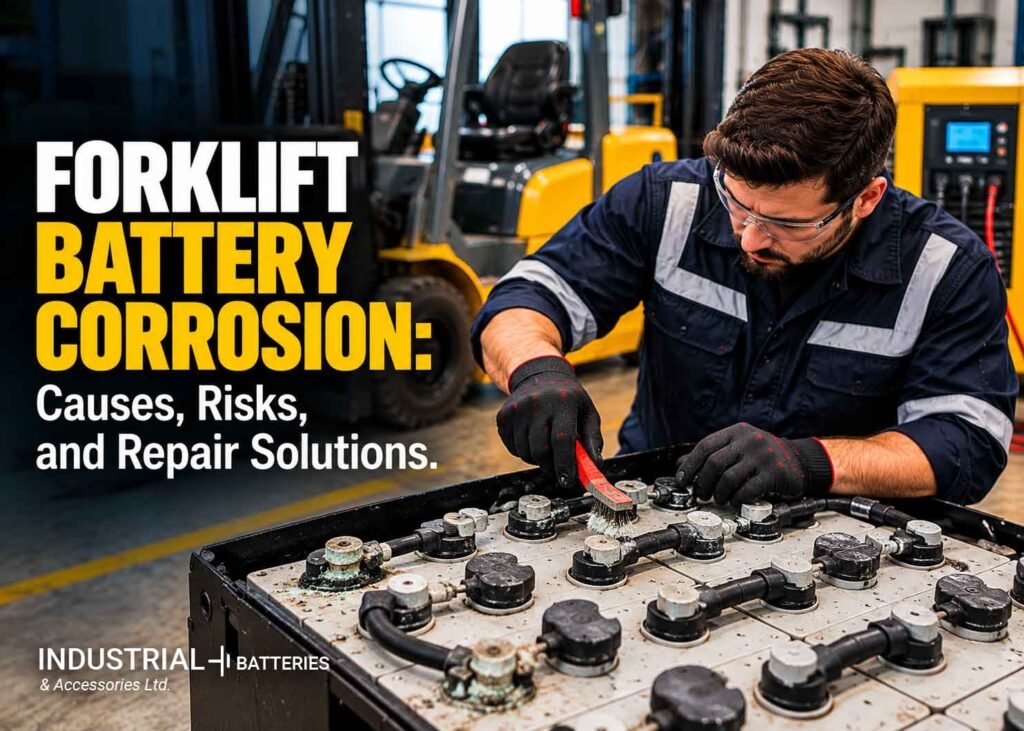
Corrosion is a buildup of salts on the battery’s metal parts. It shows up as white, blue, or green crust on posts, terminals, cable ends, and connectors. Some people say it looks like cauliflower.
Here is what happens. A lead acid battery holds lead plates in sulfuric acid. While it charges, it gives off a fine acid vapor. That vapor settles on nearby metal and reacts with it.
The color gives a clue:
- White or gray crust usually forms on lead posts.
- Blue or green crust usually forms on copper parts, like cable lugs and connectors.
A thin film is common on an older battery. A thick, wet, or spreading crust means something is off, and it needs attention.
What Are the Main Forklift Battery Corrosion Causes?
Five causes explain most cases: overfilling, overcharging, acid spills, dirt on the battery top, and loose or damaged connections. Fix the cause or the crust will return within weeks.
Check these forklift battery corrosion causes one by one:
- Overfilling. The liquid expands during charging. Watering before a charge, or adding too much, pushes acid out of the cells and onto the top.
- Overcharging. Too much charge boils the liquid and sends more vapor and spray onto the posts. A faulty charger or wrong settings is often behind it.
- Acid spills. A cracked case, a loose vent cap, or careless watering leaves acid on the surface.
- Dirt and moisture. Dust and damp hold acid residue against the metal and let current leak across the top.
- Loose connections. A loose plug or lug creates heat and tiny sparks. That speeds up wear and attracts crust.
Age also plays a part. Protective coatings wear off over time, and posts get rougher, so crust sticks more easily. That is one more reason to inspect older batteries more often.
What Risks Does Corrosion Create?
Corrosion causes power loss, heat, damaged cables, safety hazards, and a shorter battery life. It starts as a nuisance and ends as a breakdown.
Here is what it can do:
- Voltage drop. Crust acts like a barrier. The truck gets less power than the battery holds, so it feels slow or weak.
- Heat at the connection. Poor contact makes the plug or lug hot. In bad cases, heat can melt connector plastic.
- Poor charging. The charger may stop early or run longer because the connection is weak.
- Cable damage. Acid creeps into the cable and eats the copper from the inside.
- Skin and eye burns. The crust and the damp film under it contain acid.
- Damage nearby. Acid can eat into the battery tray, the truck frame, and the floor.
Here is a pattern we see often. A truck loses power on the ramp. Operators blame the battery and talk about replacing it. A technician finds a crusted, hot connector at the plug. A cleaning and a new connector restore full power at a fraction of the price.
How Do You Handle Forklift Battery Corrosion Removal Safely?
Wear protective gear, unplug the battery, neutralize the acid with baking soda and water, rinse lightly, and dry. Then protect the clean metal. Safe forklift battery corrosion removal takes about 15 minutes per battery.
Here are the steps:
- Dress for it. Wear gloves, eye protection, and an apron.
- Power down. Switch off the truck and unplug the battery.
- Check the vent caps. Make sure all caps are tight, so cleaning liquid cannot enter the cells.
- Mix the cleaner. A common mix is about a cup of baking soda in a gallon of water.
- Apply and scrub. Brush the mix over the crust. It will fizz as it neutralizes acid. Use a nylon or brass brush, not steel.
- Rinse lightly. Use a small amount of clean water. Keep it out of the cells.
- Dry fully. Wipe with a clean cloth, and let the parts air dry.
- Protect the metal. Apply a terminal protectant made for batteries.
Do not use vinegar. It is an acid, so it will not neutralize battery acid. Keep sparks and flames away, since charging gives off hydrogen gas. Dispose of used rags and rinse water as your local rules require.
When Do You Need Forklift Battery Corrosion Repair?
You need repair when cleaning does not restore clean metal, or when you find pitted posts, burnt connectors, eaten cables, or a cracked case. Cleaning removes the crust, but it cannot rebuild damaged parts.
Use this guide:
| What you find | Usual fix |
| Light crust that cleans off | Clean and protect |
| Pitted terminals or posts | Technician repair |
| Burnt or melted connectors | Replace the connector |
| Green, brittle, or swollen cables | Replace the cable |
| Crust that returns within weeks | Find and fix the cause |
| Cracked case with leaking acid | Replace the battery |
Professional forklift battery corrosion repair goes further than a wipe-down. A technician can rebuild damaged connections, replace cables, test voltage across the connection, and check the charger for overcharging. Industrial Batteries Accessories Ltd. repairs batteries of any size and make through its battery service and repairs team.
If the damage runs deeper, ask about battery regeneration or a battery pack rebuild. A new forklift battery makes sense when the case is cracked or the battery is near the end of its life.
Ask for a written quote. Corrosion repair usually costs far less than replacement, as long as you catch it early.
How Can You Prevent Corrosion Before It Starts?
Water after charging, avoid overfilling, wipe the top weekly, tighten connections, and protect clean metal. Prevention is part of everyday forklift battery maintenance, and it takes only a few minutes.
- Water after charging. Use distilled water and stop at the right level.
- Wipe the top weekly. A clean, dry top gives acid nothing to cling to.
- Check connectors every shift. Look for loose plugs, heat marks, and crust.
- Fix charger faults. A charger that overcharges will cause crust again.
- Keep vent caps tight.
- Apply a protectant after each deep clean.
- Record what you find. If crust returns, the log shows when it started.
Charge fully and avoid quick top-ups on standard lead acid batteries. A healthy charging routine means less gassing and less crust. For a deeper review, ask about an independent battery asset review.
Frequently Asked Questions
Is the white or blue crust on my forklift battery dangerous?
Yes, it can be. The crust and the damp film under it contain acid, which can burn skin and eyes. Wear gloves and eye protection whenever you touch it or clean it.
Can I clean corrosion with vinegar?
No. Vinegar is an acid, so it will not neutralize battery acid. Use baking soda and water, which is a mild base that does the job.
Does corrosion mean my battery is dying?
Not always. Light crust is a sign of care that has slipped, and it cleans off. Heavy crust that keeps returning can point to overcharging, leaks, or an aging battery, so get it tested.
How often should I check for corrosion?
Look at the posts and connectors every shift, and wipe the top weekly. Do a deeper clean whenever crust appears. Older batteries deserve extra attention.
Can corroded terminals be repaired?
Often, yes. Light damage cleans up, and worn connectors and cables can be replaced. Deeply pitted posts need a technician, who can tell you if repair is worth it.
Is Your Battery Showing Crust on the Posts?
A little crust is easy to ignore. A lot of it drains power, melts connectors, and shortens battery life. Spotting forklift battery corrosion early keeps the fix small and the truck on the floor.
The team at Industrial Batteries Accessories Ltd. can inspect your batteries and chargers, clean and repair what can be saved, and quote replacement when it cannot. Request a free estimate on the quote page, or reach the team through the contact page.