Ask five warehouse managers how often they service their forklift batteries, and you will get five different answers. The most common one is “when it acts up.”
That is the problem. By the time a battery acts up, the damage is already done. Low water exposes plates, corrosion eats the posts, and one weak cell drags the rest down.
A clear forklift battery service routine is cheaper than any of those repairs. This guide from Industrial Batteries Accessories Ltd. gives you the intervals, the tasks, and the signs that mean it is time to call for help.
How Often Should You Service a Forklift Battery?
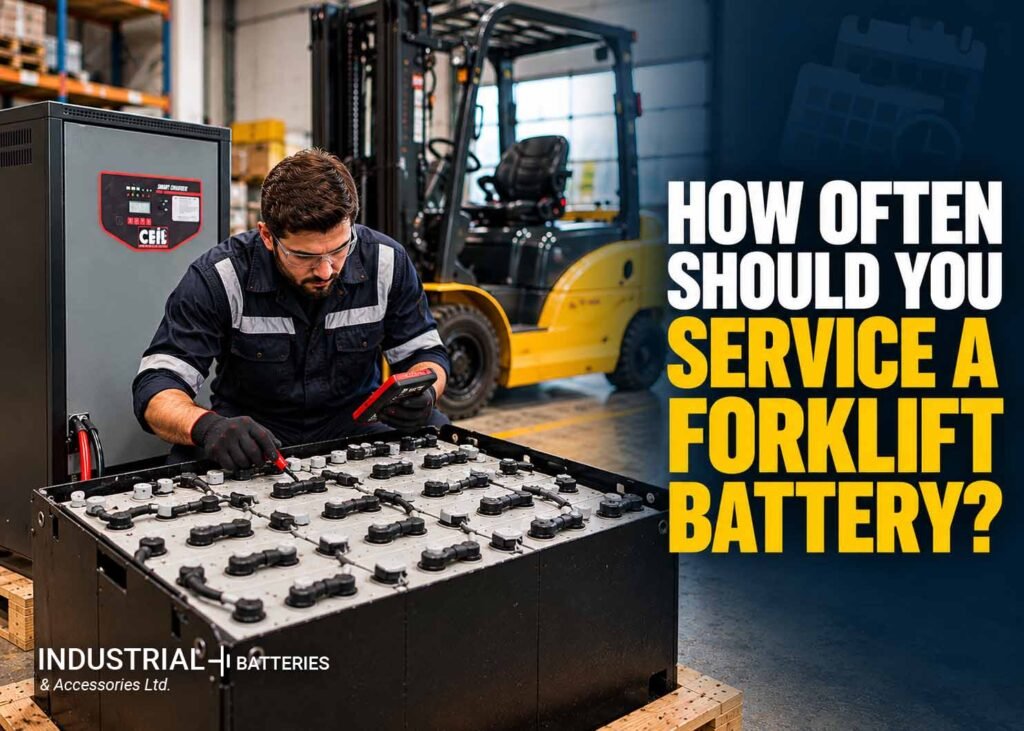
Check it every shift, water it weekly, record cell readings monthly, and book a professional test at least once a year. Heavy use means shorter gaps between each step.
There is no single number because batteries age at different speeds. A battery on one shift a day with a good charger needs less attention than one running three shifts in a hot building.
A lead acid forklift battery stores power in lead plates sitting in sulfuric acid. Each charge and discharge wears the plates a little. Good care slows that wear, and neglect speeds it up.
Use the schedule below as a starting point. Then adjust it for your site, and follow your battery maker’s guidance where it differs.
What Does a Good Forklift Battery Maintenance Schedule Look Like?
A good schedule splits tasks by frequency and by who does them. Operators handle quick checks each shift, a trained person handles weekly and monthly work, and a technician handles the yearly test.
Here is a forklift battery maintenance schedule you can adapt:
| How often | Task | Who |
| Every shift | Look for leaks, cracks, and damaged cables. Make sure the plug is secure. Charge fully. | Operator |
| Weekly | Check water levels and add distilled water after charging. Wipe the top. Inspect terminals. | Trained staff |
| Monthly | Record cell readings. Check the charger, cords, and connectors. Review the equalizing charge. | Trained staff |
| Every 3 to 6 months | Full battery and charger test, especially for heavy use or older batteries. | Technician |
| Yearly | Complete professional inspection and written report. | Technician |
Post the schedule near the charging area. Assign each task to a named person, because a task owned by everyone is owned by no one. Keep the log in one place so you can spot trends.
What Does Forklift Battery Servicing Include?
Servicing covers watering, cleaning, cell testing, connector checks, charging review, and record keeping. The first three keep the battery healthy, and the rest catch problems early.
Proper forklift battery servicing includes these steps:
- Watering. Add distilled water after charging, never before. Cover the plates, but do not overfill. The liquid expands while charging, so watering first can push acid out.
- Cleaning. Wipe the top and terminals. Dirt and acid residue let current leak across the surface and speed up corrosion. For light crust, use a baking soda and water mix, then rinse lightly and dry.
- Cell testing. A hydrometer measures the strength of the liquid in each cell. Healthy cells read close to each other. A cell that reads low is an early warning.
- Equalizing charge. This is an extended charge that evens out cell strength. Many makers suggest one every 5 to 10 charge cycles, but check yours.
- Connector and cable checks. Look for cracks, melted plastic, and loose plugs. Replace damaged parts before they fail.
- Charger review. A faulty charger can wreck a healthy battery, so include it in every check.
- Records. Write down readings, water additions, and repairs. Records help with warranty claims.
Safety comes first. Wear gloves and eye protection, and ventilate the charging area, since charging gives off hydrogen gas.
What Changes How Often Your Battery Needs Attention?
Shifts per day, battery age, room temperature, charging habits, and the type of work all change the schedule. The harder the battery works, the more often it needs a look.
Consider these factors:
- Number of shifts. A battery that runs two or three shifts without a rest heats up and wears faster. Rotating spare batteries helps.
- Battery age. After about three years, or roughly 1,500 charge cycles, shorten your testing gaps.
- Temperature. Heat speeds up water loss and plate wear. Cold lowers capacity, so a cold dock can make a good battery seem weak.
- Charging habits. Frequent quick top-ups add heat and cycles. If your site relies on them, test more often.
- Dust and dirt. Warehouses with heavy dust need more cleaning.
- Past problems. A battery that has had corrosion or a weak cell deserves closer watching.
Here is a pattern we see often. A warehouse adds a second shift and keeps the old schedule. Water checks stay weekly, but the battery now loses water much faster. Six months later, a cell fails. Adding a second shift should trigger a schedule review.
Why Does Regular Forklift Battery Service Matter?
It extends battery life, prevents breakdowns, and lowers your cost per year of ownership. Most faults cost far less to fix early than to fix after a failure.
Think of forklift battery service as insurance you can see. A few minutes each week protects a battery that costs thousands. It also protects your schedule, since a dead truck stalls the dock.
Here is what regular care gives you:
- A battery that reaches its full five year lifespan or closer to it
- Steady run time with no surprise fade
- Fewer emergency calls and less downtime
- Fewer acid spills and safer handling
- A paper trail for warranty claims
Skipped care shows up in predictable ways: shorter run time, heat, slow charging, and corrosion. If you already see them, our guide to the signs a battery needs repair or replacement covers what to do next.
Good forklift battery maintenance also helps with warranty terms. Many battery warranties expect proper care and records, so read the warranty book before you need it.
What Should You Look for in a Forklift Battery Service Provider?
Look for a provider that tests before it sells, offers repair as well as replacement, and puts its work in writing. Fast response matters too, since every hour of downtime costs you.
A good forklift battery service provider will do more than top up water. Use this checklist:
- Honest testing. The team should tell you when repair is enough instead of pushing a new battery.
- Full range of options. Repair, regeneration, rebuild, and new batteries should all be available.
- Charger checks. A healthy battery still fails on a bad charger.
- Clear reports. You should get readings and recommendations in writing.
- Local response. Industrial Batteries Accessories Ltd. works from Mississauga and handles emergency service across Ontario.
Industrial Batteries Accessories Ltd. offers independent battery asset reviews, along with battery service and repairs and battery regeneration. If a review shows a battery past saving, a battery pack rebuild or a new forklift battery may be the better choice.
Ask for a written quote that lists each task. Compare it against the cost of a breakdown, and the choice usually becomes clear.
Frequently Asked Questions
How often should I water a forklift battery?
Check the water level every week and add distilled water after charging when it is low. In hot weather or on heavy duty cycles, check more often. If you are topping up far more than before, tell your technician.
How often does a forklift battery need an equalizing charge?
Many makers suggest one every 5 to 10 charge cycles, or roughly once a month. Your battery maker’s guidance comes first, so confirm the interval for your model.
Can I service a forklift battery myself?
You can handle basics like checking for leaks, adding water, and wiping the top. Wear gloves and eye protection. Cell testing, repairs, and anything inside the case should go to a technician.
How much does forklift battery service cost?
It depends on the battery size, the tasks, and how often visits happen. Ask for a written quote and compare it against the cost of one emergency replacement. Regular service usually costs far less.
Does skipping service void my warranty?
It can complicate a claim. Many warranties expect proper care and records, so check your terms and keep a log of every check.
Ready to Put a Schedule in Place?
You now have the intervals, the tasks, and the factors that change them. The last step is to write the schedule down and give each task an owner. A battery with a clear forklift battery service routine lasts longer and fails less often.
If you want help setting it up, Industrial Batteries Accessories Ltd. can test your batteries, review your charging setup, and build a schedule that fits your site. Request a free estimate on the quote page, or reach the team through the contact page.