Choosing a forklift battery charger may seem simple at first. You may think the charger only needs to fit the battery and turn on. But in daily warehouse work, the charger does much more than that.
A good charger helps your forklift stay ready for work. It supports battery life, reduces downtime, and helps your team follow a safer charging routine. A poor charger choice can create slow charging, battery damage, overheating, and higher repair costs.
This forklift charger buying guide explains how to choose the best forklift battery charger for your business in a simple and practical way.
Why The Right Charger Matters
Your forklift battery is only as dependable as the charging system behind it. If the charger is too weak, the battery may not charge fully. If the charger is too strong or not matched correctly, it may damage the battery over time.
The right charger helps with:
- Better battery performance
- Longer battery life
- More reliable forklift run time
- Safer charging
- Less downtime
- Lower repair costs
- Smoother daily operations
Forklift battery charger selection should never be based only on price. It should be based on your battery type, work schedule, power supply, and charging needs.
Start With Your Battery Type
The first step is to know what type of forklift battery you use. Different batteries need different charging methods.
The most common forklift battery types are:
- Lead-acid batteries
- Lithium-ion batteries
- AGM or sealed batteries in some equipment
A lead-acid battery usually needs a full charge cycle, cooling time, and regular maintenance. A lithium battery can often handle shorter charging sessions during breaks, but it needs a charger designed for lithium use.
Do not assume one charger can safely charge every battery. Always match the charger to the battery chemistry.
Check The Battery Voltage
Voltage is one of the most important details in charger selection. A charger must match the battery voltage.
Common forklift battery voltages include:
- 24 volts
- 36 volts
- 48 volts
- 72 volts
- 80 volts
If the voltage does not match, the charger may not work correctly. It can also damage the battery or create safety problems.
Before buying a charger, check the battery nameplate or battery data label. This will show the correct voltage. If the label is missing or unclear, have the battery checked before choosing a charger.
Know The Battery Capacity
Battery capacity is usually listed in amp-hours, often written as Ah. This number shows how much energy the battery can store.
The charger must be sized properly for the battery’s amp-hour rating. If the charger output is too low, charging may take too long. If the output is too high, it may cause heat and reduce battery life.
This part of forklift battery charger selection is important because two batteries may have the same voltage but different capacities. They may not need the same charger size.
Understand Your Work Schedule
The best forklift battery charger for your business depends on how your forklifts are used each day.
Ask these simple questions:
- How many hours does each forklift work daily?
- Do you run one shift, two shifts, or three shifts?
- Is there enough time for overnight charging?
- Do operators need to charge during breaks?
- Do you use spare batteries?
- How much downtime can your business handle?
A one-shift operation may do well with a standard charger. A busy multi-shift operation may need opportunity charging, faster charging, or a smarter charging system.
Your charger should support your workday, not slow it down.
Choose The Right Charging Style
There are different charging styles. Each one fits a different type of operation.
Conventional Charging
Conventional charging is usually done after the battery has been used for a shift. The battery is charged fully and then allowed to cool before use.
This can work well for one-shift operations where charging can happen overnight.
Opportunity Charging
Opportunity charging means the battery is charged for short periods during breaks, lunch, or shift changes.
This can work well in busy operations, but the battery and charger must be designed for it.
Fast Charging
Fast charging is used when batteries need to return to work quickly. It can reduce downtime, but it may need stronger electrical support and better heat control.
Fast charging should only be used when the battery is built for it.
Look For Smart Charging Features
A smart forklift battery charger can adjust the charging process based on battery needs. It may help reduce overcharging, undercharging, and overheating.
Smart charger features may include:
- Automatic shutoff
- Battery temperature monitoring
- Fault code display
- Charge history
- Energy-saving modes
- Protection against wrong connections
- Charging profile control
These features can be useful if your team uses several forklifts or if different operators handle charging. Smart features help reduce mistakes and make charger use easier.
Review Your Facility Power Supply
A charger must also match your building’s electrical setup. Some chargers use single-phase power. Others need three-phase power.
Before buying a charger, check:
- Available voltage at the charging area
- Single-phase or three-phase power
- Breaker capacity
- Wiring condition
- Distance from the electrical panel
- Future expansion needs
A charger that does not match your facility may require electrical upgrades. This can add cost and delay installation.
This is why a good industrial battery charger guide always includes a power supply check.
Think About Charging Location
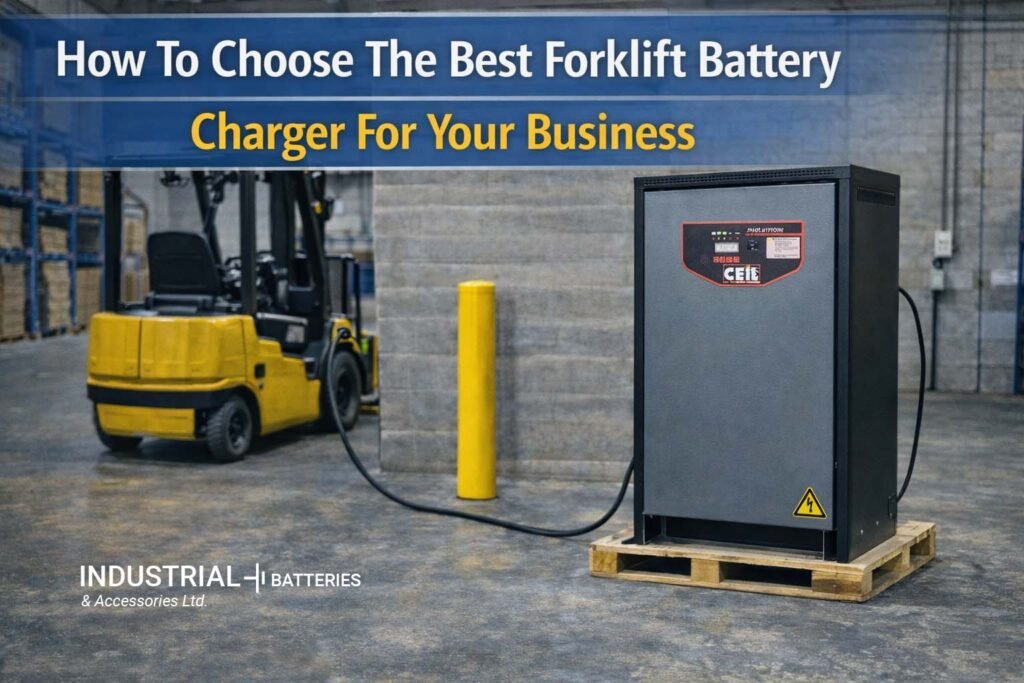
The charging area should be clean, dry, open, and safe. Chargers need airflow because they create heat during operation.
Before selecting a charger, look at where it will be installed.
Make sure there is:
- Enough space around the charger
- Good ventilation
- Protection from forklift traffic
- Easy access for operators
- Safe cable placement
- Clear floor space
- No water exposure
A charger installed in the wrong location may overheat or get damaged. Even the best charger will not perform well in a poor setup.
Check Charger Efficiency
Charger efficiency affects energy use. Older chargers may waste more power as heat. Newer high-frequency chargers are often more efficient and smaller in size.
A more efficient charger can help reduce electricity waste over time. This may matter more in facilities that charge several batteries every day.
Efficiency should not be the only deciding factor, but it is worth considering when comparing charger options.
Match The Charger To Future Needs
Do not choose a charger only for today’s setup. Think about where your business may be in the next few years.
Ask yourself:
- Will you add more forklifts?
- Will you move to lithium batteries?
- Will shifts increase?
- Will charging space change?
- Will you need faster charging later?
A charger that fits future needs may save money later. It can also make expansion easier.
Avoid Common Buying Mistakes
Many businesses run into charger problems because they choose too quickly. A charger that looks cheaper at first may cost more later if it causes downtime or battery wear.
Avoid these common mistakes:
- Buying without checking battery voltage
- Ignoring battery amp-hour rating
- Using one charger for the wrong battery type
- Choosing speed without checking battery safety
- Forgetting facility power limits
- Ignoring charger ventilation needs
- Not planning for future growth
- Buying only based on price
The right charger should match the full operation, not just the battery plug.
When To Replace An Old Charger
If your current charger is old or unreliable, replacement may be better than repeated repairs.
Consider replacement if:
- Charging takes too long
- Fault codes appear often
- Cables or connectors keep failing
- The charger overheats
- Parts are hard to find
- The charger no longer matches your batteries
- Repair costs are increasing
- Forklifts are often not ready on time
A charger upgrade can improve charging reliability and reduce daily stress for your team.
Questions To Ask Before Buying
Before you choose a charger, gather the right details. This helps avoid mistakes.
Ask:
- What battery type do I have?
- What is the battery voltage?
- What is the battery amp-hour rating?
- How many shifts do we run?
- How much charging time is available?
- Do we need conventional, opportunity, or fast charging?
- Is our power supply suitable?
- Do we need smart charging features?
- Is the charging area safe and ventilated?
- Will this charger support future needs?
These questions make charger selection clearer and more practical.
Choose A Charger That Fits Your Real Workday
The best forklift battery charger is not always the biggest, fastest, or most expensive one. It is the charger that fits your battery, your work schedule, your facility, and your long-term needs.
Take time to review your battery type, voltage, capacity, charging routine, and power supply before buying. A careful choice can protect your battery, reduce downtime, and keep your forklifts ready for daily work.
For practical guidance on forklift battery charger selection, contact Industrial Batteries Accessories Ltd. and choose a charging solution that fits your business needs.
FAQs
What Is The Best Forklift Battery Charger?
The best forklift battery charger is the one that matches your battery voltage, battery type, capacity, and daily work schedule.
How Do I Choose The Right Forklift Battery Charger?
Check the battery type, voltage, amp-hour rating, charging time, shift schedule, and facility power supply before choosing.
Can One Forklift Charger Work With Different Batteries?
Only if it is designed and approved for those battery types and settings. Using the wrong charger can damage the battery.
What Is The Difference Between Fast Charging And Conventional Charging?
Conventional charging is usually done after a shift. Fast charging charges the battery quicker but must match the battery and facility setup.
Do Smart Forklift Battery Chargers Help Battery Life?
Yes, they can help by controlling the charging process and reducing problems like overcharging, undercharging, and overheating.
When Should A Forklift Battery Charger Be Replaced?
Replace it when it fails often, overheats, charges slowly, shows repeated faults, or no longer matches your battery needs.