The truck slows down halfway through aisle six. The gauge says half charge. Ten minutes later, the forklift sits dead with a pallet in the air.
That kind of failure rarely comes out of nowhere. The most common forklift battery problems build up slowly, and most of them send warnings first. A battery that loses 20 minutes of run time this month can lose an hour next month.
This guide comes from Industrial Batteries Accessories Ltd., a Mississauga based supplier and service team. It covers the faults we see most, what causes them, and which ones you can fix yourself. It also gives you a simple way to troubleshoot before you call anyone.
What Are the Most Common Forklift Battery Problems?
Eight faults show up again and again: short run time, slow or incomplete charging, overheating, low water, corrosion, damaged cables, leaks or cracks, and uneven cells. Most begin small and get worse when ignored.
- Short run time. The battery no longer lasts a full shift.
- Slow or incomplete charging. Charging drags on, or the charger shuts off and the battery still feels weak.
- Overheating. The case feels much hotter than normal.
- Low water. The plates are exposed, or you add water far more often than before.
- Corrosion. White, blue, or green crust forms on the posts.
- Damaged cables. Frayed wires, loose plugs, or melted connectors.
- Leaks or cracks. Acid on the case or the floor.
- Uneven cells. One or two cells read far lower than the rest.
Each one has a different cause and a different fix. The next sections take them in order.
Why Does My Forklift Battery Lose Charge So Fast?
Fast drain usually means worn plates, sulfation, a weak cell, or too many deep discharges. Check the cell readings first, because one bad cell can pull down the whole battery.
Sulfation is a hard crystal buildup on the lead plates. It forms when a battery sits half charged or runs too low, and it blocks the reaction that stores power. Light sulfation can sometimes be reversed. Heavy sulfation cannot.
Stratification is another cause. Acid settles at the bottom of the cell and leaves the top weak. It often comes from repeated short top-ups instead of full charges.
Here is how these forklift battery problems usually break down:
- Cause: repeated quick top-ups. Fix: let each charge finish. An equalizing charge, which evens out cell strength, can help.
- Cause: deep discharge. Fix: recharge near 20 percent. If the battery has life left, regeneration may win back lost capacity.
- Cause: one failing cell. Fix: have a technician test and replace the cell if the rest are healthy.
- Cause: old, worn plates. Fix: a rebuild or a new battery.
What Causes a Forklift Battery to Overheat or Leak?
Overcharging, a faulty charger, heavy loads, and low water cause heat. Leaks come from cracked cases, overfilling, or loose seals. Heat is a warning. A leak is a safety problem.
A battery warms up while it works and while it charges. It should not feel hot to the touch. Hot batteries age quickly, so find the cause fast. Check the charger settings, make sure the charging room has airflow, and confirm the water level covers the plates.
Overfilling is a common mistake. The liquid expands during charging, so watering first can push acid out of the cells. Always add distilled water after charging.
If you see acid on the case or floor, stop using the battery. Wear gloves and eye protection. Mix baking soda with water to neutralize small spills on the top, then rinse lightly and dry. A cracked case is not a patch job. It needs replacement.
How Do You Fix Corrosion and Cable Problems?
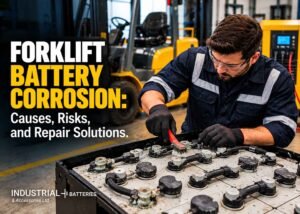
Clean the terminals with baking soda and water, rinse lightly, and dry them. Then replace any cable or connector that is frayed, burnt, or loose. Corrosion is one of the easiest forklift battery issues to fix, and one of the easiest to prevent.
Corrosion looks like crust on the posts. It slows power flow, wastes energy, and can eat into the posts over time.
Follow these steps:
- Switch off the truck and unplug the battery.
- Put on gloves and eye protection.
- Brush the crust off with a stiff brush and a baking soda mix.
- Rinse lightly, keeping water out of the cells, and dry everything.
- Check each cable and connector for cracks, melted plastic, or burn marks.
- Replace any damaged part before you plug in again.
Burnt connectors point to a deeper cause, like a loose fit or an overloaded charger. Clean parts alone will not fix that.
How Do You Handle Forklift Battery Troubleshooting Step by Step?
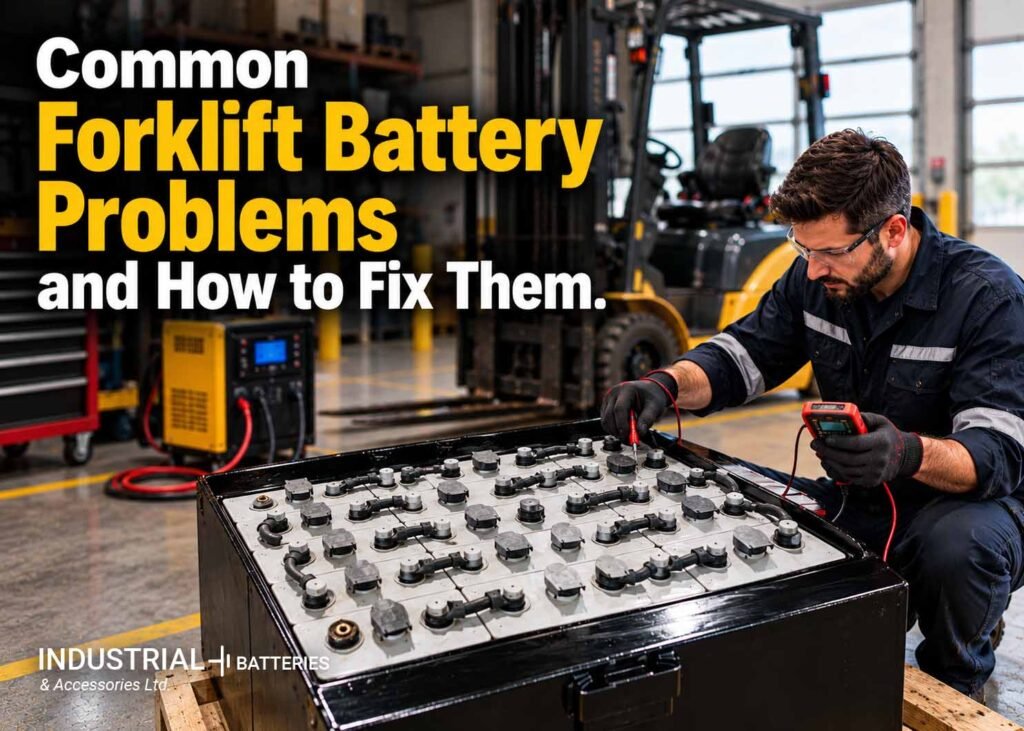
Start with a visual check, then test the cells, then check the charger. It takes about 15 minutes and shows you whether the fix is simple or needs a technician.
Good forklift battery troubleshooting follows a fixed order, so you do not guess:
- Look. Check for leaks, cracks, crust, and damaged cables.
- Check the water. Plates should be covered. Top up with distilled water after charging.
- Test each cell. A hydrometer measures the strength of the liquid in a cell. Healthy cells read close to each other.
- Check the voltage. Compare it against the battery’s rating.
- Inspect the charger. Check the cords, plugs, and any error lights. A bad charger can ruin a good battery.
- Log it. Write down the date, the readings, and what you saw.
Here is a pattern we see often. A warehouse notices the truck is slow and blames the motor. A technician checks the battery and finds one low cell dragging the rest down. The fix is one cell, not a whole battery.
When Is Forklift Battery Repair Enough, and When Should You Replace?
Repair works when the fault sits in one part, like terminals, cables, or a single cell. Replace the battery when the case is cracked, many cells are weak, or it has passed roughly 1,500 charge cycles.
Here is a quick guide:
| Problem | Usual fix |
| Corroded terminals | Clean and repair |
| Frayed cables or connectors | Replace the parts |
| One weak cell | Replace the cell |
| Over-discharged battery with life left | Regeneration |
| Several weak cells | Pack rebuild |
| Cracked or leaking case | Replace the battery |
Industrial Batteries Accessories Ltd. covers each row through its battery service and repairs, battery regeneration, battery pack rebuild, and new forklift batteries.
A simple rule helps. When forklift battery repair bills start to near the price of a rebuild, stop repairing. You are paying for life the battery no longer has. Ask for a written quote on both options and compare them, and read the warranty book before you decide.
How Can You Prevent These Problems Before They Start?
Charge fully, water after charging, keep the top clean, avoid deep discharge, and test on a schedule. Most common forklift battery problems cost far less to stop early than to fix later.
- Charge the full cycle. Do not unplug early.
- Water after charging. Use distilled water only.
- Wipe the top weekly. Dirt and acid residue speed up corrosion.
- Recharge near 20 percent. Avoid running the battery flat.
- Log cell readings monthly. A weak cell shows up early.
- Book a yearly test. Include the charger.
Charging produces hydrogen gas, so keep sparks and flames away and ventilate the room. For an unbiased check, ask about a battery asset review.
Frequently Asked Questions
Why won’t my forklift battery hold a charge?
Most often the cause is sulfation, a weak cell, or worn plates. Test each cell and check the charger. If the readings are uneven, a technician can tell you whether repair or replacement makes sense.
Can a forklift battery be repaired?
Yes, in many cases. Terminals, cables, and single cells can be repaired or replaced, and some over-discharged batteries can be regenerated. A cracked case or many weak cells usually cannot be saved.
What is the white powder on my forklift battery?
That is corrosion. It forms when acid vapor reacts with the metal posts. Clean it with baking soda and water, wearing gloves and eye protection, and find out why it formed, since low water and overfilling are common causes.
How do I know if a forklift battery cell is bad?
A bad cell reads much lower than the others on a hydrometer. The battery may also lose run time quickly or run hot. One weak cell is often fixable.
Is it safe to keep using a leaking battery?
No. Acid can burn skin, damage the floor, and corrode the truck. Stop using it, wear protection, and have it checked before it goes back to work.
Is Your Battery Showing One of These Faults?
A battery that gives you trouble today will cost more tomorrow. Spotting one of the common forklift battery problems early gives you choices. Waiting for a breakdown takes them away.
The team at Industrial Batteries Accessories Ltd. can test your battery and charger, explain what needs attention, and quote repair, rebuild, or replacement so you can compare. Request a free estimate on the quote page, or reach the team through the contact page.